

Waking up in the middle of the night is very common, and most of the time it is just a light stretch of sleep that you happened to notice. Don’t check the time, stay still in the dark, and give your attention something gentle. Many people find that helps them drift back down.
You open your eyes, the clock says 3 a.m., and you were deeply asleep a moment ago. Now you are wide awake and already doing the math on how few hours are left. This guide covers what may be behind it and what you can try tonight. None of it is a cure, and what works differs from person to person.
The short version Waking in the night is common. Keep the clock out of sight, stay still in the dark and give your attention something gentle. If it drags on, get up for a while.
Waking in the night is often part of normal sleep
Sleep is not one flat stretch. Most people drift through lighter and deeper phases during the night and surface briefly several times, usually without remembering it. Most of the time you simply roll over and drop back down.
Trouble starts when one of those surfacings turns into a full wake-up. A noise, a warm room, a full bladder or a thought can do it. Once you notice you are awake, your mind switches on, and that is the part you can influence.
What can cause you to wake in the night
There is rarely one cause, and these are general possibilities, not a diagnosis:
- The room. Heat, cold, light or noise can pull you up out of a light phase.
- Drinks before bed. A full bladder is an easy reason to wake.
- Caffeine and alcohol. Some people find afternoon caffeine or a drink near bedtime makes their sleep lighter.
- Worries. Daytime concerns tend to surface in the quiet. Racing thoughts at night has ideas for that.
- An uneven schedule. Bedtimes and wake times that move around can make nights feel less settled.
If you wake at the same time every night
Some people wake around 2 or 3 a.m. almost every night. Once it becomes a pattern, you may start bracing for it, and that tension can keep it going. Pick the one cause above that sounds most like you and adjust only that for a week or two. If it carries on for weeks or leaves you struggling in the daytime, see the section on talking to a doctor below.
Why it feels so much worse than it is
At 3 a.m. everything seems larger. The house is quiet, nothing distracts you, and tiredness makes small worries look heavy. Checking the clock adds pressure: “I have to be up in four hours, I must sleep now.” That pressure is alert, not sleepy, and it makes falling back to sleep harder.
Seeing it this way can take some of the power out of it. Being awake for a while in the night is annoying, but it is not an emergency.
Things to try when you wake up
Keep the clock out of sight
Counting the hours left feeds the pressure. Turn the clock or phone face down before bed so you cannot check it without effort.
Stay still and keep things dim
Try lying quietly with your eyes closed and your body relaxed. Even if you are not asleep, resting is not nothing. Avoid turning on bright lights. If you must get up, use the dimmest light you can.
Give your attention something gentle
Many people find it easier to follow something simple than to force their mind blank. You could:
- feel your breath for a few rounds without changing it
- listen to a steady sound and follow its rhythm
- walk through a familiar place in your mind, step by step
 Following something simple is easier than forcing your mind to go blank.
When you notice you have slipped into planning or worrying, just come back. There is no need to scold yourself.
Get up if it drags on
If you have been awake for what feels like a long time and you are getting frustrated, it is commonly recommended to get up, sit somewhere dimly lit and do something quiet until you feel sleepy again. Lying in bed irritated can teach your brain to link the bed with being awake. We cover this in what to do when you cannot sleep.
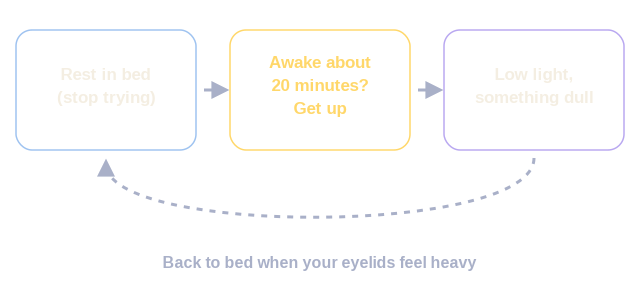 If you are getting frustrated, get up for a while and go back when you feel sleepy.
Skip the phone
Scrolling wakes the mind up more. If you must look at something, keep it dim and dull.
What to look at in the evening to wake less often
Some people find these habits make night waking less likely. They are common suggestions, not guarantees:
- keep a steady bedtime and wake time
- go easy on caffeine in the afternoon and alcohol close to bedtime
- keep the bedroom a comfortable temperature
- wind down for half an hour before bed
Our guide to a bedtime routine that sticks can help you build the last one.
A steady sound for the quiet hours
A silent room can make small noises, and your own thoughts, easier to notice. Some people like a constant sound that is still there when they wake. Water is a gentle option: it is rounder and softer than rain. You can listen to it for thirty seconds on our water sounds page.
When to talk to a doctor
Waking now and then is normal. But if it happens most nights, goes on for weeks, leaves you exhausted in the daytime, or comes with loud snoring, pauses in breathing, low mood or constant worry, please talk to a doctor or another health professional. They can look for causes that an article or an app cannot.
Where migg fits
In migg, you spend the night in a cozy room with a koala. The Poolside, Midnight room plays water sounds, and the sound loops all night, so if you wake up, the same calm sound is still there. There is also a sleep timer if you would rather it stop. You can read about the Poolside, Midnight room first. migg is free to download, and the yearly plan has a 7-day free trial.
migg is not a medical device and does not treat any condition. If you are looking for medical or clinical help with your sleep, it is not the right tool.
This article is general information, not medical advice. If sleep problems last for weeks or affect your days, please talk to a doctor.